World Cup Football and the Imagined National Unity
And Their Children After ThemWorld Cup football and the imagined national unity names a temporary sense of belonging that the 1998 tournament makes tangible across France, including Heillange. Television coverage, a debate over the diversity of the French team, and a dramatic match turn separate viewers into a crowd that imagines itself as one. Yet the scene does not establish that ordinary prejudice or social division has disappeared: the narrative sets the celebration against the contradictions of daily life and the private unease that persists within it.
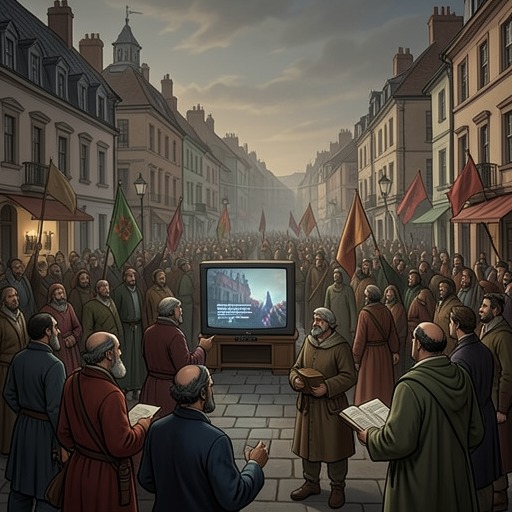
Television and a shared national moment
The movement toward collective feeling begins through the television set. When Anthony Casati hears that France has reached the semifinals, he crosses E.Leclerc to look at the televisions being sold at promotional prices. He chooses a forty-inch Sony for twelve thousand francs, with payment spread over six interest-free installments. Already overdrawn, he pays a deposit by check and expects that his mother might help if necessary. The purchase is both a concrete financial decision and a way to join an event being presented as nationally consequential.
The shop’s screens show highlights from France’s game against Italy, with children watching alongside other customers. Anthony recognizes the players, and his attention joins the excitement gathering around the broadcast. The narration places this response across differences of geography and income: viewers in Heillange and Paris, at the top and bottom of the pay scale, are imagined as following the same contest. The television synchronizes attention, making a national audience seem present to itself even though its members remain in separate places.
At home, the match is still in the future, but television reports and interviews have already made anticipation into a shared ritual. Anthony watches accounts of French supporters and their children, and the commentators describe the team as playing at home amid popular fervor. The new set promises an unusually immediate view of the game, while Anthony’s growing excitement draws him into the wider expectation. But this participation does not erase his private vulnerability: after switching the television off during a commercial break, he sees his reflection in the dark screen and becomes sad again, then turns the set back on.
The promise and limits of black-white-brown
The question of what the tournament might leave behind emerges in a conversation between Anthony’s cousin and Nath. Nath rejects the idea represented by the label black-white-brown, which refers to the French team’s black, white, and Arab players. She regards the claim that the team’s diversity will have a lasting social effect as a passing enthusiasm. Her skepticism is informed by her work as a police officer and by her habit of looking at public optimism protectively rather than taking it at face value.
Anthony’s cousin argues that a French victory could leave people with the knowledge that they can get along. Nath challenges this hope with examples from their ordinary surroundings: complaints about a Turkish mason and Arab workers, and irritation at Portuguese neighbors. The exchange makes the central tension explicit. A diverse national team can serve as a compelling image of coexistence, but that image exists beside everyday judgments about migrant workers and neighbors. The tournament offers a possible language of solidarity, not proof that social relations have been transformed.
The match as temporary encounter
At a bar, the match briefly brings Anthony Casati and Hacine together within the same public excitement. The two recognize one another, then turn their attention to the television. When Lilian Thuram scores in the forty-seventh minute, the spectators erupt; Hacine raises his fists, and Anthony reaches him in the celebration. Their response is not presented as the resolution of their history. Rather, for that instant, the game gives their attention and joy a common object, interrupting the distance between them.
Thuram’s second goal, in the seventieth minute, intensifies the feeling that the crowd has become a single body. The narration describes a fantasy in which differences and old debts seem temporarily to vanish, and the country appears bound together in fraternity. That sweeping language is significant precisely because its unity is temporary and imagined: it records how complete the experience feels from inside the celebration, not a lasting settlement of the conflicts that preceded it.
Heillange celebrates, with boundaries still in view
After France wins and reaches the final, Heillange spills into a town-wide celebration. Cars fill the streets, flags appear at windows, people paint their faces in the national colors, and strangers toast, embrace, and kiss. The police watch with indulgence as the town displays an energy it had not recognized in itself. The celebration momentarily recasts a place marked by prolonged bad luck as a community capable of collective enthusiasm.
The language of belonging is audible in the repeated use of the first-person plural: people speak as though they themselves have won and advanced to the final. Algerian flags also appear in the streets, extending the visible national celebration beyond a single emblem of French identity. At the same time, a local body-shop owner’s earlier banner supporting Zidane and the temporary closure of the French National Front office place distinct political signs within the same setting. The evidence shows these details alongside the celebrations without suggesting that they settle the town’s divisions.
The novel also places this football celebration beside another public spectacle: Heillange’s Bastille Day fireworks, when a crowd watches the same display and the town looks in one direction. Both scenes show how shared events can momentarily organize a community’s attention. The World Cup, however, makes that common focus part of a broader national story, carried through television, team colors, and the language of collective victory. Its force lies in making unity feel possible and immediate; its limit lies in the return of private sadness and familiar social contradictions once the moment passes.